
When Did Facebook Start Running Ads?
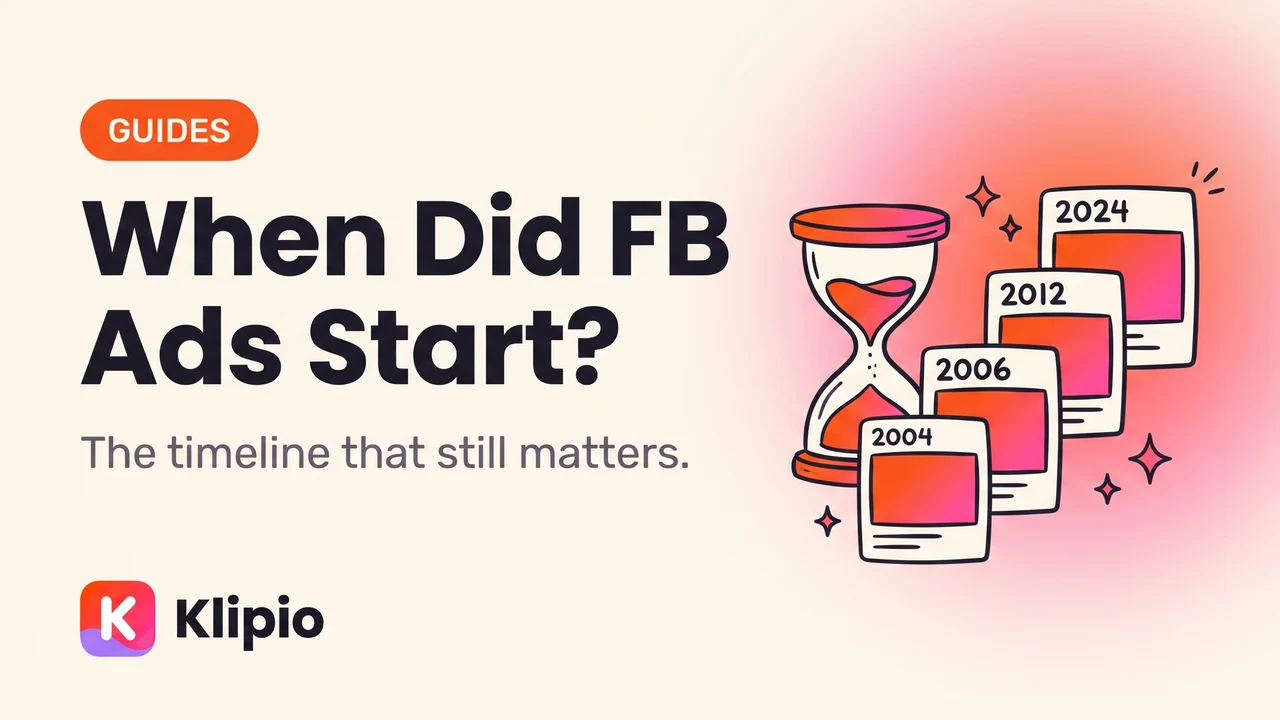
Facebook started running ads in 2004, the same year the site launched, in the form of cheap campus-targeted notices called Flyers. The platform most media buyers mean by "Facebook ads" — the self-serve auction with targeting and a dashboard — launched in November 2007.
Everything after that is a story about placement and measurement, and it explains why today's Ad Library looks the way it does.
When did Facebook start showing ads to users?
- Flyers were sold on a per-day or per-click basis for a few dollars and shown to students at a specific college.
They were closer to a classifieds listing than to modern advertising. No auction worth the name, no pixel, no optimisation. A local pizza place or a campus society bought a slot, and students at that school saw it.
That's the honest answer to when Facebook started running ads: from year one, but barely.
What happened in 2007, and why is that the date people cite?
In November 2007 Facebook announced a three-part advertising system: Pages for businesses, Social Ads, and Beacon.
That launch is the one that matters. It introduced self-serve buying, so any advertiser with a credit card could run ads without talking to a salesperson. It introduced targeting on the profile data users had already given the site. And it tied ads to business Pages, which is still the structure today — every ad you see in the Ad Library is attached to a Page.
Beacon, the part that broadcast your purchases on other sites into your friends' feeds, was a privacy disaster and was killed within two years. The self-serve platform survived and became the business.
When did Facebook ads move into the News Feed?
Sponsored Stories arrived in 2011, and mobile News Feed ads launched in 2012.
For the first eight years, ads sat in a sidebar column that people had trained themselves to ignore. Putting the ad in the feed itself, in the same shape as a post from a friend, changed the economics completely. It is the single most important product decision in the platform's history.
The timing was not a coincidence. Facebook went public in May 2012 with almost no mobile revenue, and the stock was punished for it. Mobile feed ads fixed that within about two years.
When did Instagram ads start?
Instagram ran its first ads in late 2013 with a handful of brands, and opened to all advertisers through the Facebook ad system in 2015.
Facebook bought Instagram in 2012 for about a billion dollars. Three years later the two ad systems were joined, so one campaign could run across both. That merge is why the public Ad Library today shows Instagram ads alongside Facebook ones and why researchers can see Instagram ads in the library at all.
Audience Network, which extended Meta ads to third-party apps, launched in 2014. Messenger ads followed in 2017.
When did the Facebook Ad Library launch?
The Ad Archive launched in May 2018 for political and issue ads in the US, and became the worldwide Ad Library covering all active ads in March 2019.
This is the part that changes what's possible for competitor research. Before 2018, seeing a rival's ads meant being in their target audience, or paying a scraper. After 2019, every active ad from any advertiser worldwide is public and free to browse at facebook.com/ads/library.
| Era | How you saw a competitor's ads | Reliability |
|---|---|---|
| 2007–2017 | Be in their audience, or buy scraped data | Poor, partial, expensive |
| 2018 | Political and issue ads only, US first | Narrow but official |
| 2019 onward | Every active ad, any advertiser, worldwide | Complete for active ads, free |
The library exists because of political-ad transparency pressure after 2016, not because Meta wanted to help media buyers. That origin explains its limitations: it shows creative and a start date, but no spend, no reach and no engagement for normal commercial ads. What it does and doesn't expose is covered in the Meta Ad Library guide.
When did Facebook become Meta?
The company renamed itself Meta Platforms in October 2021. The ad products were renamed over the following months: Facebook Ads Manager became Meta Ads Manager, and Facebook Business Suite became Meta Business Suite.
The ads themselves didn't change. This is why documentation, tutorials and search queries still mix "Facebook ads" and "Meta ads" freely, and why the Ad Library is still hosted at a facebook.com URL.
2021 also brought the bigger disruption: Apple's App Tracking Transparency prompt in iOS 14.5 cut the signal Meta used to attribute conversions. Costs rose, measurement got noisier, and the platform leaned harder on automation and broad targeting. That shift is the reason Advantage+ campaigns exist in their current form.
Why does the history matter for running ads now?
Because three of those dates still shape daily decisions.
2007 set the account structure. Ads belong to Pages, Pages are public, and that is precisely why the Ad Library can show you any advertiser's creative. Your competitor's ads are visible for a structural reason that isn't going away.
2012 set the creative bar. Feed placement means the ad has to survive a thumb moving at speed. Format and length choices follow from that, not from brand guidelines — see which Facebook ad type performs best.
2019 set the research method. Everything in modern competitor research assumes a free public library of active ads. Ad longevity became the usable performance signal precisely because the library shows a start date and nothing else useful. An ad that has run for four months is being paid for because it works. That logic is the whole basis of reading ad longevity.
What the timeline does not tell you
Two honest caveats.
First, dates vary slightly by source because "launched" can mean announced, tested with partners, or generally available. Instagram ads are the clearest case: 2013 for the first partner ads, 2015 for open access. Both are cited, and both are right.
Second, the history is not a strategy. Knowing that mobile feed ads launched in 2012 doesn't tell you what to run this quarter. For that, the useful move is studying what is running right now — how to study winning Facebook ads covers the routine.
FAQ
When did Facebook start showing ads?
Facebook ran its first paid placements in 2004 as Flyers, a low-cost per-campus notice format. The self-serve advertising platform with targeting and business Pages launched in November 2007, which is the date usually meant by "Facebook ads started".
What was the first Facebook ad?
The first ads were Flyers in 2004 — simple text-and-image notices bought by local businesses and campus groups, priced at a few dollars a day and shown only to students at one college. They had no auction, no targeting beyond the school, and no measurement worth the name.
When did Facebook ads become profitable?
Facebook's advertising business grew steadily from 2007, but mobile News Feed ads launched in 2012 turned it into the dominant revenue engine. Mobile went from almost nothing at the May 2012 IPO to the majority of ad revenue within about two years.
When did the Facebook Ad Library launch?
The Ad Archive launched in May 2018 for US political and issue ads, then expanded worldwide in March 2019 as the Ad Library, covering every active ad from any advertiser. It remains free and requires no account to browse.
When did Facebook become Meta?
Facebook Inc. renamed itself Meta Platforms in October 2021. Ads Manager and Business Suite were rebranded to Meta over the following months, though the Ad Library still sits on a facebook.com URL and both names are used interchangeably.
Are old Facebook ads still visible anywhere?
Not for normal commercial advertisers. The Ad Library shows only ads that are currently active, so paused and finished ads disappear from it. EU advertisers and political ads are the exceptions, where inactive ads are retained under transparency rules.
The Klipio extension adds a download button to every ad in the Meta Ad Library: one click per ad, or bulk-save a whole search as a ZIP with a searchable swipe file inside. Free, no sign-up.
Get the free Ad Library downloaderKlipio reads a competitor's live Meta ads, ranks them by how long they have been running — the honest signal that an ad is profitable — and turns the winning angle into on-brand creative for your own brand. 3-day free trial.
Start free — 3-day trial →