
Which Facebook Ad Type Works Best? Honest Answer
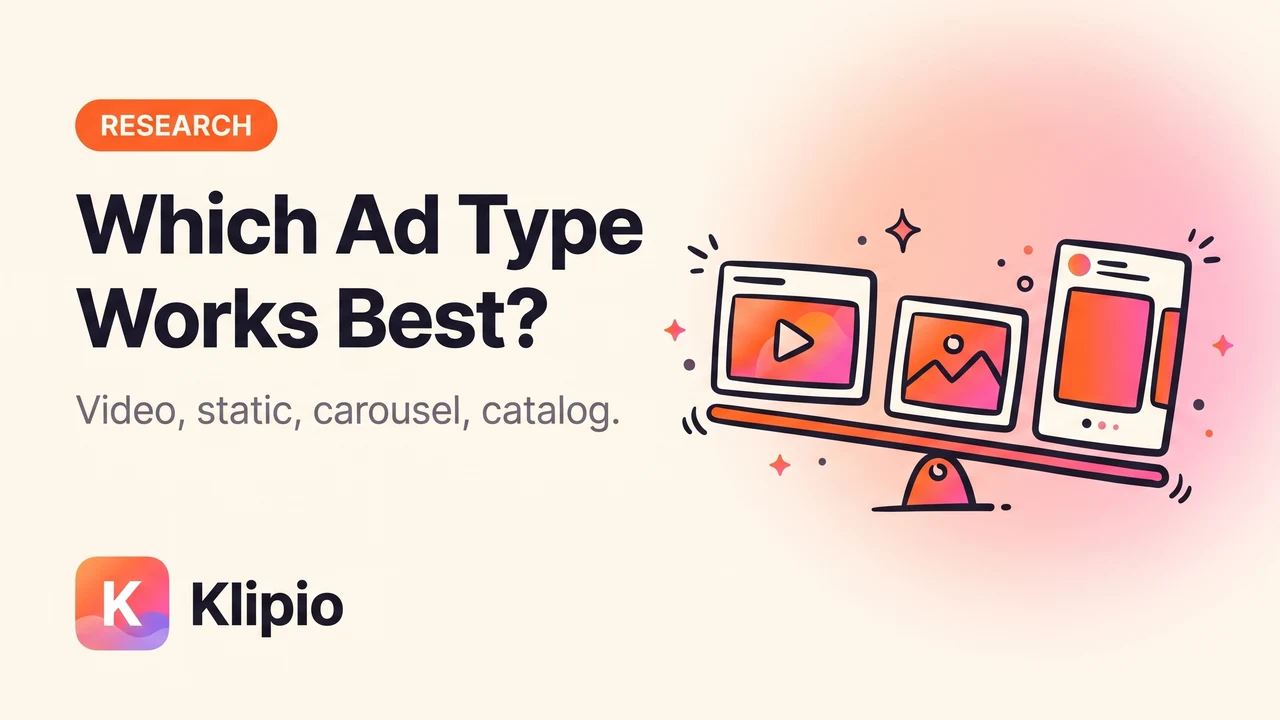
No single Facebook ad type is most effective across the board. Format is the third most important variable in an ad, behind the offer and the angle, and every format has categories where it wins. Anyone quoting a universal winner is describing their own account.
What follows is what each format is genuinely good at, how to choose without guessing, and how to check the answer for your category in about ten minutes.
Why doesn't one format win everywhere?
Because format determines how a message is delivered, not whether the message is any good.
A clear offer in a plain static image beats a confusing offer in a beautiful video, every time. Swap the offers and the result flips. The format is a container.
Three things sit above it in importance.
The offer. What the person gets, and what it costs. Nothing downstream fixes a weak one.
The angle. Which problem you're solving and for whom. Finding winning ad angles covers pulling these from competitor ads.
The creative execution. The hook, the first frame, the first line.
What is each format actually good at?
| Format | Best job | Weakest at |
|---|---|---|
| Video | Building interest in something unfamiliar | Fast, simple, warm-audience conversions |
| Single image | Stating one clear fact or offer | Explaining anything that needs demonstration |
| Carousel | Comparing options, showing a range or a sequence | Cold audiences with no context |
| Collection | Browsing a visual range on mobile | Single-product businesses |
| Catalog | Harvesting existing demand across many SKUs | Creating demand in the first place |
| Lead ad | Collecting contact details with no page load | Anything requiring real consideration |
Video is the format most often cited as most effective, and on cold audiences it usually earns that. It can demonstrate, show a person, and build belief in a way a still can't. It's also where most budget is wasted, because a bad video costs far more to make than a bad image.
Single image is underrated. It loads instantly, states a price or a fact, and is cheap to iterate. On retargeting and on offer-led ads, static frequently beats video.
Carousel works when there's a genuine sequence or comparison — before and after, a range, steps in a process. It underperforms when brands use it just to fit more product photos in. Facebook carousel ad examples shows the ones that work.
Collection and catalog are ecommerce machinery. Efficient at converting existing intent, weak at generating it. Facebook catalog ads explained covers the mechanics.
Lead ads trade lead quality for volume, which is the right trade for some businesses and wrong for others. Facebook lead ad examples goes deeper.
For the full map of every option, Facebook ad formats explained is the reference piece.
How do I pick a format without guessing?
Start from the job the ad has to do.
Then check two constraints.
What can you actually produce well? A team that can't make good video will get more from excellent statics than mediocre video. Production capability is a real input, not an excuse.
Where is the audience? Reels and Stories placements are vertical and sound-off by default. An ad built for a horizontal, sound-on world underperforms there regardless of format.
That second point matters more than the format debate. A static that reads in one second beats a video whose point arrives at second six, because most people never reach second six.
How do I find out what works in my category?
Read the ads that are already surviving there.
Open the free Meta Ad Library at facebook.com/ads/library, no account needed, and search your top competitors. For each one, note the format of every live ad and the "Started running on" date.
Two patterns tell you almost everything.
Format mix. If eight of a competitor's ten live ads are video, video is probably what works for that audience — or at least what they've committed to.
Longevity by format. An ad running for four months has survived repeated performance reviews. If their long-runners are static and their new ads are video, they're testing video and paying with static. Ad longevity as a performance signal explains why the date is the most useful field on the card.
Do this across five competitors and you get a category answer, which is far more useful than a global one.
Ads disappear when they're paused, so save what you find that day. Our free extension, the Klipio Meta Ad Library downloader, adds a download button to every ad and can pack a whole search into a single ZIP with a CSV and a searchable board. It's free with no account, and it's ours, so weigh that accordingly.
How should I test formats in my own account?
Test one variable at a time or you learn nothing.
Running "video vs image" with different offers, different hooks and different copy tells you which ad won, not which format. Hold the angle and the offer constant, change only the format.
Give each variant enough conversions to leave the learning phase before judging. Underfunded tests produce confident conclusions from noise, which is the most common way accounts get stuck.
A creative testing framework that works sets out the structure properly.
What actually predicts a winning ad?
Across accounts, the same things keep showing up, and none of them are the format.
A specific promise. A first second that earns the next three. Proof a stranger would believe. A price framed against something familiar. And a landing page that continues the ad's argument instead of starting a new one.
Get those right and most formats work. Get them wrong and none do.
FAQ
What type of Facebook ad is most effective?
There's no universal winner. Video tends to lead on cold audiences because it can demonstrate and build belief, while single images often win on retargeting and offer-led ads because they load instantly and read fast. The offer and the angle matter more than either.
Do video ads perform better than image ads on Facebook?
Often on cold traffic, and often not on warm traffic. Video is better at explaining something unfamiliar; static is better at stating a clear offer to someone who already knows you. Test them against each other with the same angle and offer, or the comparison is meaningless.
Which Facebook ad format is best for ecommerce?
Most ecommerce accounts run a mix: video or static for prospecting, and catalog or collection ads to convert people who have already shown intent. Catalog formats are efficient at harvesting demand but poor at creating it, so they work alongside persuasive creative rather than replacing it.
How can I tell which ad formats work for my competitors?
Search them in the free Meta Ad Library and record the format and "Started running on" date for each live ad. Formats that appear in their longest-running ads have survived performance review, which is the closest public evidence of what works in that category.
Does ad format matter more than targeting?
On modern Meta buying, yes. With Advantage+ audience expansion, the creative largely determines who responds and therefore who the system pursues, so format and angle carry more weight than the audience settings you enter.
How many ad formats should I run at once?
Enough to cover the jobs your funnel has, usually two or three. A prospecting format that builds interest, a conversion format that states the offer, and a catalog or retargeting format for people who already engaged is a common, workable spread.
The Klipio extension adds a download button to every ad in the Meta Ad Library: one click per ad, or bulk-save a whole search as a ZIP with a searchable swipe file inside. Free, no sign-up.
Get the free Ad Library downloaderKlipio reads a competitor's live Meta ads, ranks them by how long they have been running — the honest signal that an ad is profitable — and turns the winning angle into on-brand creative for your own brand. 3-day free trial.
Start free — 3-day trial →