
How Long Has an Ad Been Running? Spot Winners by Longevity
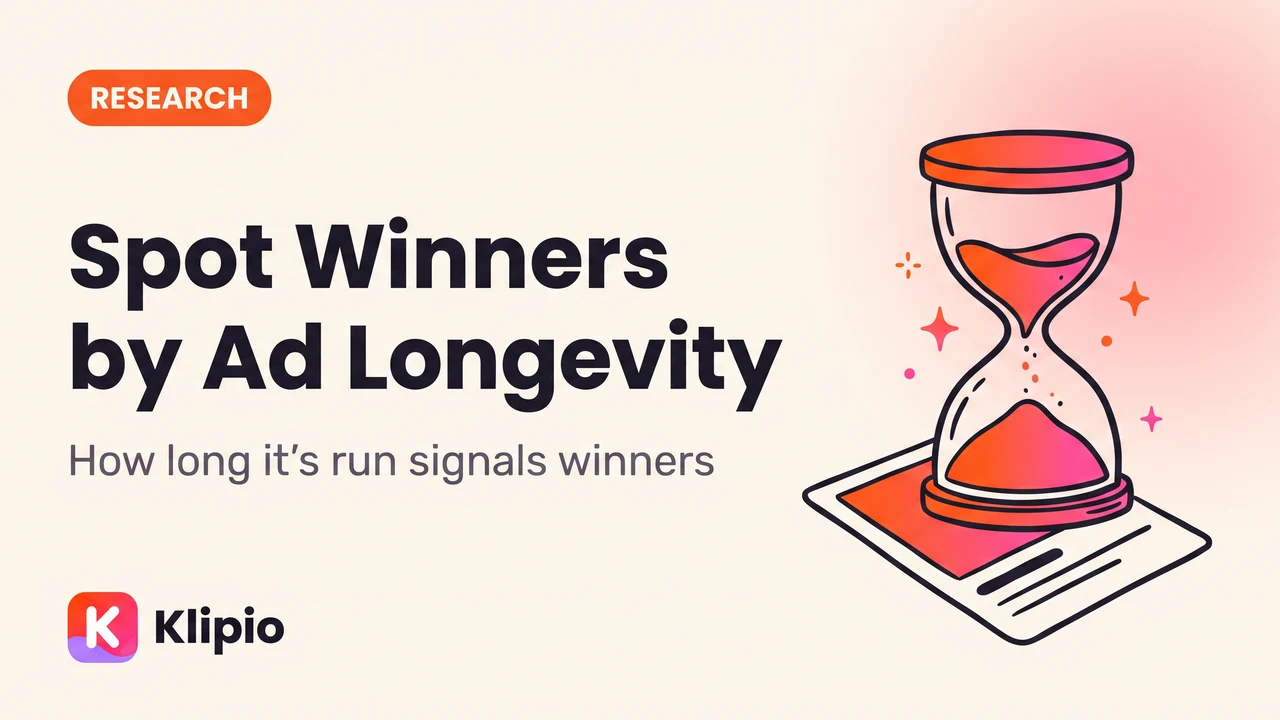
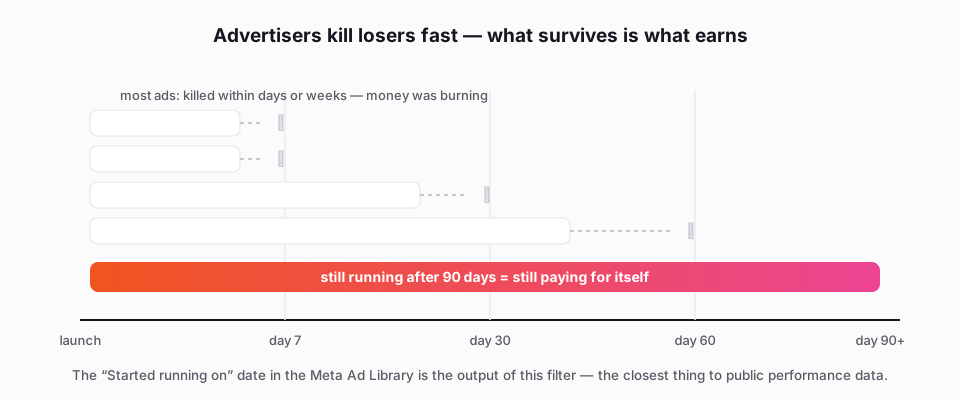
To see how long any Facebook ad has been running, open it in the Meta Ad Library (facebook.com/ads/library) and look at the "Started running on" date shown with every ad. And that date matters far more than it looks: an ad still running after 60 to 90+ days is almost certainly making its advertiser money, which makes the start date the closest thing to public performance data Meta will ever give you.
That second sentence is the whole thesis of this post, so let me earn it properly.
Why is ad longevity a performance signal at all?
Meta shows no performance data for normal ads. Open any competitor's ads in the Ad Library and you'll find no spend, no clicks, no ROAS, no engagement counts. (The exceptions are narrow: US political ads show spend ranges, and EU viewers get limited targeting data.) On paper, you know nothing about how any ad is doing.
But advertisers vote with their budgets, and that vote leaks.
Think about what has to be true for an ad to still be live 90 days after launch. Someone with access to the actual performance numbers has looked at that ad through weeks of budget reviews, creative refreshes, and month-end reporting, and every single time decided to keep paying for it. Media buyers kill losing ads fast, usually within days, because every day a loser runs is money burned. Nobody sentimental survives in this job.
So the ads that survive are the ads that earn. Not sometimes. Structurally. The system that decides which ads keep running is the advertiser's own profit motive, and it runs continuously, with full access to the private data you can't see. The "Started running on" date is where the output of that system becomes public.
I'd go as far as saying this: a competitor's ad longevity is more trustworthy than their own case studies. Case studies are marketing. Ninety days of continuous spend is an involuntary confession.
Where do I find the "Started running on" date?
In the Meta Ad Library, search a competitor's Facebook Page name (full walkthrough in the Ad Library guide). Every ad card in the results displays "Started running on" plus the date, right above the creative, along with the platforms it runs on.
Two details worth knowing:
The date is per ad, not per campaign. If a brand launched a concept in March and a fresh variant of it in July, each shows its own start date. That's useful, not annoying: it lets you see both when a concept was born and when it was last considered worth reinvesting in.
Grouped variants show a combined card. When an advertiser runs multiple versions of one ad, the library sometimes groups them ("This ad has multiple versions"). Click into the ad to see the versions. A concept with many versions AND an old start date is the strongest possible combination: proven long-term, still being actively scaled.
Note also what the date doesn't mean. "Started running on June 3" tells you nothing about budget size. A winner at $50/day and a winner at $5,000/day look identical. Longevity tells you the ad works; it can't tell you how big it is.
When does the longevity signal lie?
Here's where I have to be honest, because the signal has real limits, and pretending otherwise would make this post less useful, not more.
Brand and awareness campaigns can run long without direct ROAS. Big brands run ads whose job is reach and memory, not purchases. Nike doesn't kill an awareness ad because last week's ROAS dipped; it may not be measured on ROAS at all. If the advertiser is a household name, discount long-running polished brand films and pay attention to their direct-response-shaped ads instead: the ones with offers, prices, and hard CTAs.
Retargeting ads run long by design. An ad shown only to recent site visitors serves a small, constantly refilling audience. It doesn't fatigue like a cold-traffic ad, so it can run for a year without being an exceptional performer. You usually can't see targeting from outside (EU excepted), but you can often smell retargeting: "Still thinking it over?", cart imagery, urgency copy aimed at someone who already knows the product.
Seasonal resets break the clock. Brands often stop everything and relaunch around big sales periods, so a genuinely old winner can show a recent start date because it was paused for Black Friday and relaunched in December. If a "new" ad looks suspiciously polished and confident, it may be a returning champion, which is one reason keeping your own archive over time matters (more on that below).
Small advertisers can just be asleep. A tiny account might leave a mediocre ad running for months out of neglect. The signal is most reliable for advertisers who are visibly active: many ads, regular new launches, variant families. Activity proves someone is watching the numbers, which is what makes their survivors meaningful.
None of these caveats break the signal. They just mean longevity is evidence, not proof, and it's strongest for direct-response ads from active advertisers.
What's the actual workflow for finding a competitor's winners?
Here's how I turn one competitor's Ad Library page into a creative brief, in about twenty minutes.
Step 1: Sort mentally by age. The library won't sort by date for you, so scroll the whole list and note every ad older than about 90 days. This is the "90-day club," and it is, with the caveats above, that brand's profit engine on display. Ads between 30 and 90 days are promising; under 30 days are unproven tests, interesting for direction but not evidence.
Step 2: Mine the club for patterns, not ads. Lay the long-runners side by side and ask what repeats. The pattern shows up on a few axes: the angle (what desire or problem the ad speaks to), the hook (how the first three seconds or the first line earns attention), and the format (UGC testimonial, static with a price flag, founder-to-camera, carousel of use cases). One long-running ad is an ad. Three long-running ads sharing an angle is a market truth.
Step 3: Brief the pattern, not a copy. This is the line that keeps you out of trouble and, frankly, makes better ads. You never reuse their asset or recreate it beat for beat; that's a legal risk (not legal advice, ask a lawyer) and a strategic dead end, because their creative is tuned to their brand equity and offer. Instead the brief reads like: "Proven pattern: skeptical-customer testimonial that opens by voicing the price objection, then justifies cost-per-use. Produce our version with our customer, our product, our numbers." You're borrowing their expensively-earned learning about the audience, and expressing it in your own creative. Every serious media buyer works this way.
Step 4: Repeat weekly, and watch the deltas. A single snapshot shows you today's survivors. Checking weekly (my full routine is in how to see competitors' Facebook ads) shows you which new tests die within two weeks and which get promoted into variant families. Watching a competitor's tests fail is free negative knowledge: angles you now don't have to spend money disproving.
Which Facebook ads are most effective, then?
Across every account I've run or studied, the ads that survive longest are rarely the prettiest. They're direct-response ads built on one clear angle: a testimonial that voices a real objection, a demo that shows the product doing its one job, an offer stated plainly with a reason to act. Video tends to dominate cold traffic, statics and carousels earn their keep in retargeting and catalog work, but format is the costume, not the character. The 90-day club of almost any niche is full of unglamorous ads that answer one question a buyer actually has.
That's also why longevity analysis beats browsing "inspiration" galleries. Galleries show you what designers admire. Start dates show you what customers respond to.
Where do tools help with longevity tracking?
The Ad Library's weakness is memory. Ads vanish the moment an advertiser stops them, there's no export, and there's no way to see how a library looked last month. Longevity analysis wants exactly what Meta doesn't provide: a record over time.
The manual fix is saving ads as you research. Our free extension, Klipio's Meta Ad Library Downloader, adds a download button to every ad in the Ad Library and, in bulk mode, packs a competitor's entire library into one ZIP (disclosure: Klipio is our product; the extension is free, no account, and runs entirely in your browser). Files are named by advertiser and date, and every export includes a CSV of all ads plus a searchable swipe board, so a snapshot from each month becomes your own longevity dataset. The full save workflow is in downloading Facebook Ad Library videos. Beyond that, Klipio's paid product watches your rivals' libraries continuously and tracks how long each ad has survived, which is this whole post automated; I'll leave it at that one mention.
FAQ
How long does it take for a Facebook ad to start running?
Most ads clear Meta's review and start delivering within a few hours, though review can take up to 24 hours and occasionally longer for sensitive categories. The ad appears in the Ad Library once it starts running, and its "Started running on" date reflects that day.
Which Facebook ads are most effective?
For most advertisers, direct-response ads built on one proven angle: testimonial videos that voice a real objection, product demos, and plainly stated offers. You can verify this empirically in any niche by checking start dates in the Ad Library; the ads that survive 90+ days of someone's real budget are overwhelmingly of this kind.
What signals in the Ad Library tell you an ad is converting?
Three main ones: age (a "Started running on" date 60 to 90+ days old means the advertiser keeps choosing to fund it), variant count (many versions of one concept means it's being scaled, not tested), and persistence across seasons. Discount the signal for obvious brand-awareness campaigns and retargeting-shaped ads, which can run long without exceptional direct performance.
The Klipio extension adds a download button to every ad in the Meta Ad Library: one click per ad, or bulk-save a whole search as a ZIP with a searchable swipe file inside. Free, no sign-up.
Get the free Ad Library downloaderKlipio reads a competitor's live Meta ads, ranks them by how long they have been running — the honest signal that an ad is profitable — and turns the winning angle into on-brand creative for your own brand. 3-day free trial.
Start free — 3-day trial →