
Estimate Competitor Facebook Ad Spend: What Works
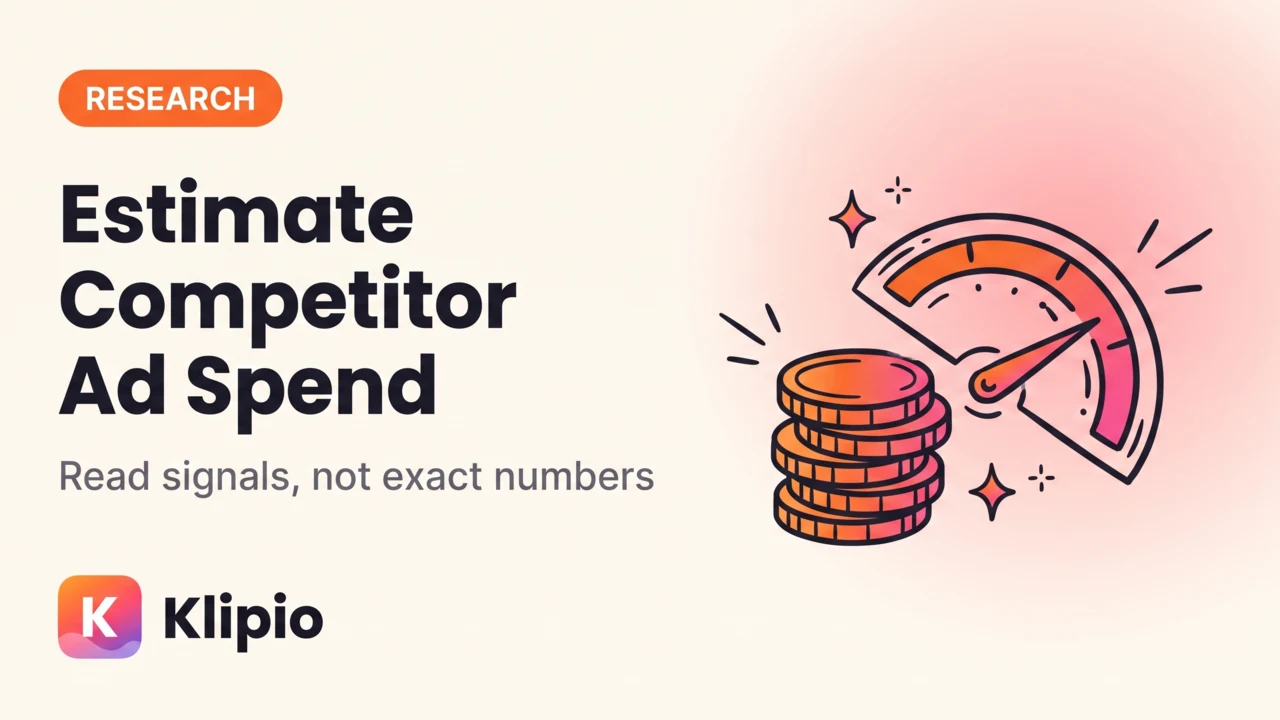
There's no way to get an exact competitor Facebook ad spend number, because Meta doesn't publish it for normal commercial advertisers. What you can do is estimate competitor Facebook ad spend directionally, by reading how many ads are live, how long each one has run, and how often new creative shows up.
None of that gives you a dollar figure. It gives you something almost as useful: a confident sense of who's actually investing and who's just testing.
Why Meta Doesn't Show Exact Ad Spend Numbers
Meta's Ad Library is free and public, and it shows every active ad from any advertiser in the world. What it doesn't show, for ordinary commercial ads, is spend, budget, clicks, or results — our full guide to the Meta Ad Library covers everything it does expose.
That's a deliberate choice. Meta treats advertiser spend as private business data, the same way it wouldn't hand you a competitor's ad account. The one exception is US political and social-issue ads, which carry disclosed spend ranges by law.
What the Facebook Ad Library Actually Shows You
Before you can estimate anything, it helps to know exactly where the wall is. The Ad Library gives you rich creative data and zero financial data for typical advertisers.
- Every active ad running now
- The date each ad started
- Creative, copy, and which platforms it runs on
- Exact spend or daily budget
- Clicks, ROAS, or conversions
- Ads that already ended, outside the EU
EU advertisers are the exception. Under EU transparency rules, the library also shows their inactive ads and some limited targeting and reach detail. For everyone else, once an ad is paused, it disappears — you only ever see what's live right now.
How Much Do Competitors Spend on Facebook Ads? Reading the Proxy Signals
Since spend is hidden, the real question becomes: what public signals correlate with spend? Three of them do a decent job.
Ad count. A brand running 40 live ads is spending more than one running 3, almost by definition — someone has to pay to keep 40 ad sets active.
Ad longevity. Advertisers pull losing ads fast because they're burning money for nothing. An ad still running after eight weeks has earned its keep, which usually means real budget behind it.
Posting cadence. A brand shipping new creative every few days is iterating on a working formula, not testing a single idea on a shoestring budget.
Ad Longevity: The Closest Thing to a Spend Signal
Of the three signals, longevity is the one worth watching most closely. Every ad card in the library shows a "Started running on" date, and that date is the closest thing Meta gives you to a performance signal.
The logic is simple: nobody pays to run a losing ad for three months. If a competitor's carousel has been live since May, it's converting well enough that they haven't touched it. Our deeper breakdown of how to read Facebook ad longevity as a performance signal walks through exactly how to use those dates.
A Framework to Estimate Competitor Facebook Ad Spend
Put the signals together and you get a repeatable way to estimate competitor Facebook ad spend without ever seeing a real number.
- Count active ads. Search the brand in the Ad Library and note the total.
- Check longevity. How many of those ads have run 30+ days versus under a week?
- Watch cadence over 2-3 weeks. Are they adding new creative weekly, monthly, or barely at all?
- Cross-reference category norms. A DTC apparel brand running 50 long-lived ads is a heavier spender than the category average; 5 ads that rotate weekly suggests a smaller, scrappier budget.
Run this on two or three competitors at once and you get relative rankings — who's the biggest spender in your space, who's pulling back — even without absolute figures. Our guide on how to see competitors' Facebook ads systematically covers the search and tracking workflow in more depth.
Free vs Paid Ways to Get a Facebook Ad Spend Estimate
The Ad Library itself is free and gives you the raw signals above. A handful of paid tools layer a modeled spend range on top of that same public data, which can save time if you're tracking dozens of competitors.
| Tool | Starting price | What it adds |
|---|---|---|
| Meta Ad Library (native) | Free | Raw ad data, no spend estimate |
| BigSpy | $9/mo (free tier available) | Spend-range estimates across platforms |
| Minea | $49/mo | Spend and performance estimates by ad |
| Pipiads | $49/mo | Spend estimates, mostly TikTok/e-commerce focus |
| Foreplay | $59/mo ($49/mo annual) | Ad tracking + spend signals, swipe files |
| PowerAdSpy | $69/mo | Spend estimates across search filters |
| Atria | $129/mo | Spend and creative intelligence |
| AdSpy | $149/mo (no free trial) | Large ad database, spend filtering |
Every figure in that table is a starting price as of writing, so check the vendor before you commit. One thing worth flagging: MagicBrief, a tool that used to appear in these comparisons, was acquired by Canva and shut down on July 31, 2026 — its features now live inside Canva Grow. Our roundup of the best ad spy tools compares these in more detail.
If you'd rather work from the raw ads directly, our free Meta Ad Library Downloader adds a one-click download button to every ad in the library, plus a bulk "Find all ads" mode that pulls a competitor's entire active set into one organized ZIP with a searchable swipe file. It doesn't estimate spend — nothing free does honestly — but it makes it fast to pull every ad and its start date for the longevity read above. (Disclosure: that's our tool.)
Common Mistakes When Estimating Competitor Ad Budget
The biggest mistake is treating any tool's spend number as fact. It's a range built from a model, and models built on the same limited public data will disagree with each other.
The second mistake is judging spend from a single snapshot. A competitor's ad count on one Tuesday tells you less than watching it for three or four weeks.
The third is ignoring category context. A $500/day competitor ad budget is enormous for a niche accessory brand and modest for a national retailer — the number only means something next to a baseline.
FAQ
How much do competitors typically spend on Facebook ads?
There's no single answer — it ranges from a few dollars a day for a small DTC brand testing creative to tens of thousands a day for national retailers. The signals in the Ad Library (ad count, longevity, cadence) tell you where a specific competitor sits relative to others in your category, even without a hard number.
Can I see a competitor's exact Facebook ad budget?
No. Meta does not expose spend or budget for standard commercial ads in the public Ad Library, and the official API only covers political and EU-regulated ads. Any exact-looking number from a third-party tool is a model's estimate, not a figure Meta released.
What's the best free way to estimate competitor Facebook ad spend?
Use the Meta Ad Library directly: count a competitor's active ads, check the "Started running on" date on each, and watch how often new creative appears over a few weeks. Those three signals, read together, are free and reasonably reliable.
Does ad longevity really indicate spend?
It's the strongest free signal available. Advertisers stop paying for ads that lose money, so an ad still running after weeks or months is very likely profitable and backed by ongoing budget — see our full breakdown of reading ad longevity as a performance signal.
Do paid ad spy tools give accurate spend numbers?
They give estimated ranges, not confirmed figures, built from the same public signals you can read yourself. Tools like AdSpy ($149/mo), Foreplay (from $59/mo), and Minea (from $49/mo) are useful for scaling this across many competitors at once, but treat their numbers as directional.
Why can't I see a competitor's paused or ended Facebook ads?
Outside the EU, Meta only shows ads that are currently active — once a competitor pauses one, it drops out of the library entirely. EU transparency rules require advertisers there to also disclose ended ads, which is one reason EU brands are easier to research historically.
The Klipio extension adds a download button to every ad in the Meta Ad Library: one click per ad, or bulk-save a whole search as a ZIP with a searchable swipe file inside. Free, no sign-up.
Get the free Ad Library downloaderKlipio reads a competitor's live Meta ads, ranks them by how long they have been running — the honest signal that an ad is profitable — and turns the winning angle into on-brand creative for your own brand. 3-day free trial.
Start free — 3-day trial →