
Facebook Ad Account Structure That Actually Scales
A good Facebook ad account structure is smaller than most people build. For the large majority of advertisers, three campaigns and a handful of ad sets carries the whole account, because every extra ad set splits the same budget into a weaker learning signal.
The instinct to build one ad set per audience comes from an older version of the platform. Meta's delivery system now does most of the audience work itself, which changes what structure is for.
What is Facebook ad account structure?
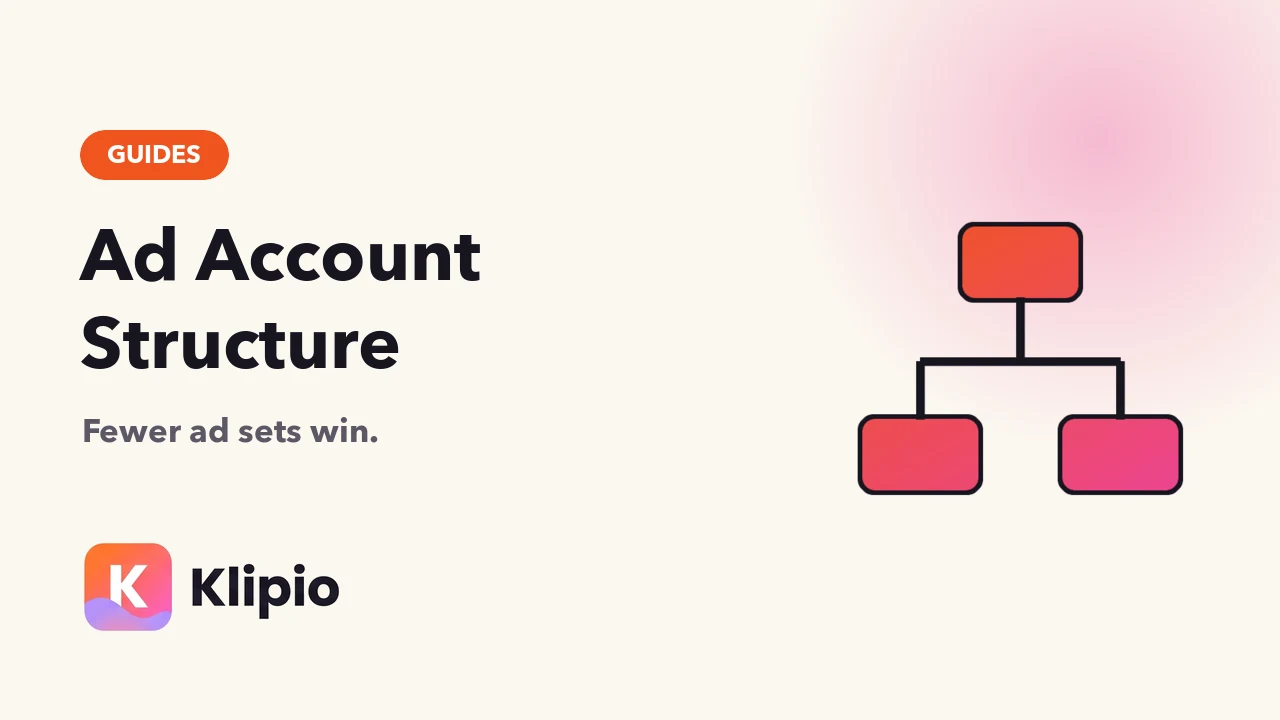
Structure is the three-level hierarchy Meta gives you and the choices you make inside it.
- Campaign — sets the objective and, with Advantage campaign budget, the budget.
- Ad set — sets audience, placements, optimisation event, and schedule.
- Ad — the creative and the copy.
Structure decisions are almost entirely about the middle level. How many ad sets you run, and what separates them, determines how fast the account learns and how stable your costs are.
| Level | What it controls | How many you need |
|---|---|---|
| Campaign | Objective, budget strategy | 2–4 for most accounts |
| Ad set | Audience, placements, optimisation | 1–3 per campaign |
| Ad | Creative, copy, destination | 3–6 live per ad set |
Why do fewer ad sets usually perform better?
Meta optimises at the ad set level, and it needs a volume of conversion events to exit the learning phase and deliver stably. Roughly 50 conversions per ad set per week is the commonly cited threshold, and the learning phase is where an under-fed ad set gets stuck.
Split a $100/day budget across eight ad sets and each one gets $12.50/day. At a $40 cost per purchase, no ad set reaches the volume it needs, so all eight deliver unpredictably.
Put the same $100 into one ad set and it clears the threshold comfortably.
This is the single most common structural mistake in small and mid-sized accounts. The account looks organised and performs badly, because organisation was optimised for the human reading the dashboard rather than for the system spending the money.
What structure should most accounts use?
Three campaigns, organised by funnel stage.
1. Prospecting. Broad or lightly filtered audience, optimised for your primary conversion event. This is where most of the budget sits. One or two ad sets.
2. Retargeting. Site visitors, add-to-carts, video viewers, and engagers. One ad set, often one campaign-level budget. Keep it small; retargeting pools are finite and burn out.
3. Testing. A separate campaign where new creative runs with a fixed daily budget, judged on early signals rather than on final ROAS. Winners graduate into prospecting.
Some accounts add a fourth campaign for a distinct offer or product line with different economics. That is a legitimate reason to split. "This audience feels different" is not.
Should you split by audience, offer, or creative?
Split by offer, because offers have different economics. A $19 trial and a $300 annual plan need different targets, so they should not share a budget.
Do not split by audience unless the audiences need different budgets, different creative, or different bids. Lookalikes, interests, and broad now overlap heavily, and Meta's delivery will find the responsive people inside a wider pool anyway. We wrote about how that plays out in Advantage+ and what it actually changes.
Do not split by creative. Creative belongs at the ad level, inside one ad set, so the algorithm can move spend toward the winner. Splitting creative into separate ad sets forces you to make that judgement manually on thinner data.
How many ads should run in one ad set?
Three to six live ads is the practical range.
Below three and you have no internal competition, so a fatiguing ad keeps spending. Above six and Meta concentrates delivery on two or three anyway, leaving the rest with too little data to judge.
Refresh on a schedule rather than waiting for a collapse. Frequency climbing while CTR falls is the standard signal, covered in what creative fatigue looks like.
Keep naming consistent so you can read the account quickly six months later. A simple convention — date, angle, format, iteration — makes reporting far easier than a folder of "Video 3 FINAL v2".
When should you rebuild the structure?
Rarely, and never in response to one bad week.
Legitimate reasons to restructure:
- You launched a genuinely different offer with different margins.
- You expanded into a market with different costs and needs its own budget.
- Your account has accumulated twenty ad sets and most get under $10/day.
- You are moving from ad-set budgets to campaign budgets, or back.
Illegitimate reasons: results dipped, a competitor launched something, or a post suggested a new structure. Restructuring resets learning across everything you touch, which costs you a week of stable delivery.
How does competitor research fit into structure?
It informs the testing campaign, not the hierarchy.
Structure is internal — budgets and delivery. What competitors run tells you what to put inside the structure: which angles are worth testing and which formats a category has settled on.
The Meta Ad Library shows every active ad from any advertiser, with a "Started running on" date on each card. Ads that have run for months are the ones worth studying, because advertisers stop paying for ads that lose money. That longevity signal is the closest thing to public performance data, and we broke down how to read it in judging ads by how long they have run.
The library has no download button and ads disappear when they are paused, so anything you want to keep has to be saved deliberately. Our free extension, the Meta Ad Library downloader, adds a download button to each ad and can pack a whole search into one ZIP with a searchable index.
Feed what you find into the testing campaign. Keep the account structure boring.
What does a finished account look like?
For a mid-sized ecommerce advertiser spending $150/day:
- Prospecting — 1 campaign, Advantage campaign budget, 1 broad ad set, 5 ads. ~$100/day.
- Retargeting — 1 campaign, 1 ad set covering 30-day site visitors and add-to-carts, 3 ads. ~$25/day.
- Testing — 1 campaign, 1 ad set, 4 new ads on rotation. ~$25/day.
Three campaigns, three ad sets, twelve ads. That account will outperform the same budget spread across fifteen ad sets in almost every case, and it takes ten minutes a day to read rather than an hour.
The work that moves the number is creative and offer. Structure just needs to stop getting in the way.
FAQ
How many campaigns should a Facebook ad account have?
Two to four for most advertisers: prospecting, retargeting, and a testing campaign, plus one more if you run a second offer with different economics. More campaigns split budget without adding information.
Is it better to have more ad sets or fewer?
Fewer, in nearly every case. Meta optimises at the ad set level and needs roughly 50 conversions per ad set per week to deliver stably, so splitting a modest budget across many ad sets keeps all of them under-fed.
Should I separate lookalike and interest audiences into different ad sets?
Usually no. Those audiences overlap heavily and Meta's delivery will find responsive people inside a broader pool. Separate them only if they need genuinely different budgets, creative, or bids.
How many ads should I run per ad set?
Three to six live ads. Fewer gives you no internal competition against fatigue; more spreads data so thinly that most ads never get a fair test, since delivery concentrates on two or three anyway.
Does restructuring reset the learning phase?
Yes. Meaningful edits to an ad set — budget, audience, optimisation event — push it back into learning. That is why restructuring should follow a real change in the business rather than a bad week of results.
How do I structure a Facebook ad account for multiple products?
Group products that share economics into one campaign and separate only where margin, price point, or target cost genuinely differ. A $19 product and a $300 product should not compete for the same budget inside one ad set.
The Klipio extension adds a download button to every ad in the Meta Ad Library: one click per ad, or bulk-save a whole search as a ZIP with a searchable swipe file inside. Free, no sign-up.
Get the free extensionKlipio reads a competitor's live Meta ads, ranks them by how long they have been running — the honest signal that an ad is profitable — and turns the winning angle into on-brand creative for your own brand. 3-day free trial.
Start free — 3-day trial →