
Meta Campaign Objectives Explained
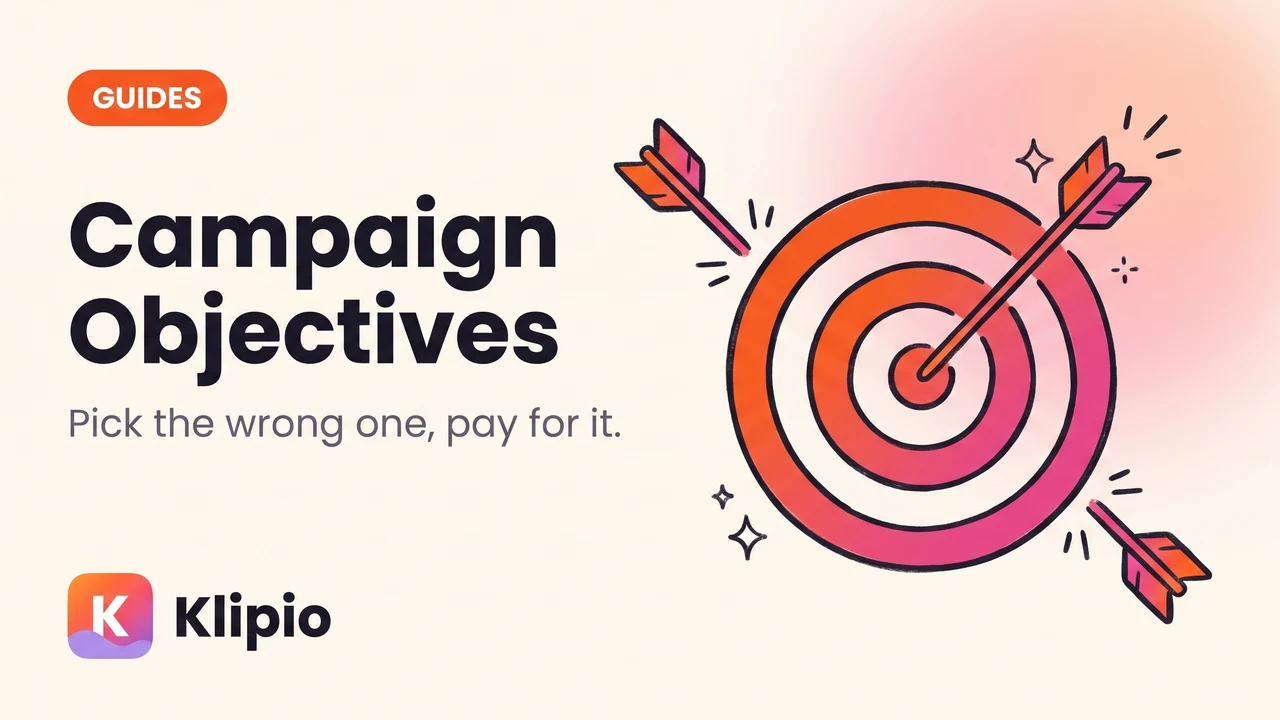
Meta has six campaign objectives: Awareness, Traffic, Engagement, Leads, App promotion and Sales. The objective is not a label, it is an instruction telling the system which humans to go and find, which makes it the most consequential setting in the whole account.
Pick Traffic when you want purchases and Meta will faithfully deliver you people who click things and buy nothing.
What are the Meta campaign objectives?
Six, each optimising for a different action.
| Objective | Optimises for | Use it when |
|---|---|---|
| Awareness | Reach and impressions | You need to be seen by many people cheaply |
| Traffic | Clicks or landing page views | The next step is genuinely reading something |
| Engagement | Reactions, video views, messages | Video views, messaging flows, event responses |
| Leads | Form submissions or calls | Service businesses, B2B, high-consideration |
| App promotion | Installs and in-app events | You have an app |
| Sales | Purchases and other pixel events | Ecommerce, anything transactional |
The objective decides your audience, not just your reporting. Two identical ads with different objectives will reach two different sets of people.
Which objective is best for sales?
Sales, optimised for purchase, whenever you have the conversion volume to support it.
Meta looks at who has been buying and goes hunting for people who look like them. That is a fundamentally different search from "who clicks links", and it is why the same creative can produce wildly different results under two objectives.
The catch is volume. The system needs roughly 50 optimisation events per ad set per week to learn properly, and below that it is guessing. What that means in practice is covered in the Meta learning phase explained.
That middle branch is the one most small accounts need. Optimising for a higher-frequency event keeps you inside conversion-based buying rather than dropping down to clicks. As purchase volume grows, move the optimisation event down toward the sale.
Should I use Traffic or Sales?
Sales, unless the click genuinely is the goal.
Traffic campaigns are seductive because the reported cost per click is low. That number is low because cheap clicks are the easiest thing in the entire auction to buy. There is a large population of people who tap ads reflexively and purchase nothing, and Traffic optimisation finds them very efficiently.
Legitimate uses of Traffic:
- Driving readership to content that is measured on its own terms.
- Warming a cold audience with an article before retargeting them with an offer.
- A brand-new pixel with literally zero events, as a short bridge.
The metrics that tell you whether a campaign is actually working sit in Meta ads KPIs explained.
What is the Engagement objective for?
Video views, messaging conversations, event responses, and page interactions.
It is the most misused objective in the list. Engagement is cheap, and cheap results feel like progress, but reactions on an ad are not a business outcome unless something downstream depends on them.
Where it genuinely earns its place:
- Messaging businesses. If the sale happens in a chat thread, message optimisation is your conversion objective.
- Video view retargeting pools. Building an audience of people who watched 50 percent of a video, then retargeting them with a Sales campaign.
- Local events. Response volume is the actual goal.
Outside those cases, engagement metrics are diagnostics rather than results.
Can I change the objective on a live campaign?
No. The objective is fixed at campaign creation, so changing it means building a new campaign.
This is worth knowing before you build, because it means a mis-set objective cannot be quietly corrected. Duplicate the campaign with the right objective, launch it alongside, and pause the old one once the new one is delivering.
The setup checklist that avoids most of these problems is in what to do before your first Meta campaign.
Which objective should I use with a small budget?
One objective, one campaign, until it works.
The instinct with a small budget is to spread it across awareness, traffic and sales so every stage is covered. That splits already-thin data across three learning phases and none of them finish. The result is three campaigns that never leave learning and a report full of noise.
Better: pick the objective closest to revenue that can accumulate events, put the whole budget there, and let it stabilise. Add a second campaign only when the first one has a cost per result you trust.
How the auction actually spends that budget is explained in how the Meta ad auction works.
How do I tell which objective competitors are using?
You cannot see it directly, but the ad tells you a lot.
The Meta Ad Library at facebook.com/ads/library shows every active ad from any advertiser worldwide, free and without an account. The call to action, the destination, and the copy structure make the intent fairly obvious. "Send message" is an engagement or messaging campaign. A product page with price framing is a sales campaign. A lead form is Leads.
The more useful signal is longevity. Each card shows a "Started running on" date, and advertisers keep paying only for ads that work, so ads running for months are the tested ones. Reading a category that way tells you where the money in your niche is actually being spent.
Ads vanish from the library when they are paused, so exports beat bookmarks. Our free Meta Ad Library Downloader collects a whole search into one ZIP with a searchable swipe board and a CSV of every ad, including the CTA and dates.
For the wider picture of how Meta advertising fits together, see what Meta advertising is.
The short version
Six objectives, one decision: optimise for the action closest to revenue that gets enough weekly volume to learn. Use Sales for anything transactional, move the optimisation event up the funnel when volume is thin, and treat Traffic as a content tool rather than a sales tool. Cheap clicks are the easiest thing in the auction to buy and the least likely to be worth anything.
FAQ
What are the Meta campaign objectives?
Awareness, Traffic, Engagement, Leads, App promotion and Sales. Each one tells Meta which action to optimise for, which changes who sees the ad.
Which Facebook campaign objective is best for sales?
The Sales objective, optimised for purchase, provided you have enough weekly purchases for the ad set to learn. Below that, optimise for a higher-volume event such as add to cart and move down later.
Should I use Traffic or Sales objective?
Sales, unless the click itself is the goal. Traffic optimisation finds people who click cheaply, which is a different population from people who buy.
What is the Engagement objective for?
Video views, messaging conversations, event responses and page interactions. It is the right objective when the sale happens in a chat thread or when you are building a video-view audience to retarget.
Can I change the objective of a live campaign?
No. The objective is locked at campaign creation, so you have to duplicate the campaign with the correct objective and pause the original.
Which objective should I use with a small budget?
One objective in one campaign, chosen as close to revenue as your event volume allows. Splitting a small budget across several objectives leaves every ad set stuck in the learning phase.
The Klipio extension adds a download button to every ad in the Meta Ad Library: one click per ad, or bulk-save a whole search as a ZIP with a searchable swipe file inside. Free, no sign-up.
Get the free Ad Library downloaderKlipio reads a competitor's live Meta ads, ranks them by how long they have been running — the honest signal that an ad is profitable — and turns the winning angle into on-brand creative for your own brand. 3-day free trial.
Start free — 3-day trial →